How Cameras Capture Light

Ethan Sullivan
| 14-07-2026
 · Science Team
Cameras are among the most important imaging technologies developed through advances in physics, optics, electronics, and computer science.
Although they are widely used for photography and videography, cameras also play essential roles in scientific research, medicine, astronomy, engineering, environmental monitoring, and industrial inspection.
Every image captured by a modern camera results from a carefully coordinated sequence of optical, electronic, and computational processes that convert light into digital information. Understanding these scientific principles reveals how modern imaging systems accurately record and reproduce visual information across numerous scientific and everyday applications.
How electromagnetic waves transmit information and why radio remains an essential communication technology
Building trust and confidence through modern cybersecurity and data protection
Explore the evolution of space exploration, from early discoveries to future missions
A quiet phase of release and reflection!
How galaxies form and change over time in the cosmos
Discover the surprising challenges and solutions for living on the Red Planet
Light and Optics: Forming an Image
The operation of every camera begins with light. When light reflects from an object, it enters the camera through a lens designed to collect and focus incoming rays onto an image sensor. This process relies on the refraction of light, which bends light rays as they pass through precisely engineered glass elements.
The amount of light entering the camera is regulated by the lens aperture, an adjustable opening within the lens. A wider aperture allows more light to reach the sensor, improving performance in low-light conditions, while a narrower aperture increases depth of field, allowing more of the scene to appear sharply focused.
Image Sensors: Converting Light into Digital Signals
Modern digital cameras replace traditional photographic film with electronic image sensors, most commonly CMOS (Complementary Metal-Oxide Semiconductor) and CCD (Charge-Coupled Device) sensors.
These sensors contain millions of microscopic photosensitive elements that detect incoming light. When photons strike these light-sensitive elements, they generate electrical charges proportional to the intensity of the incoming light. The camera then converts these electrical signals into digital data, enabling the reconstruction of an image with accurate brightness, color, and contrast.
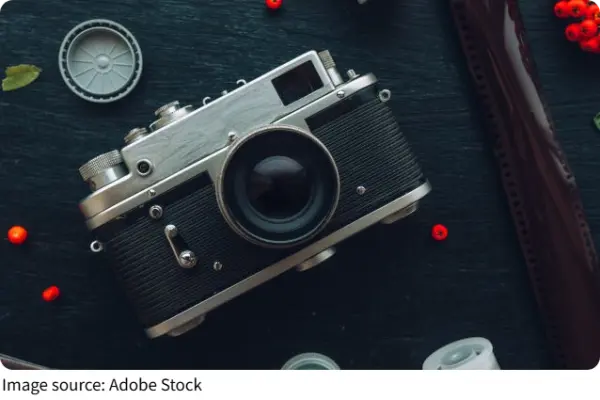
Exposure: Controlling Image Brightness
Producing a properly exposed image depends on balancing three fundamental parameters, collectively known as the exposure triangle:
- Aperture: Regulates the amount of light entering the camera while influencing depth of field.
- Shutter Speed: Controls the duration for which the image sensor is exposed to light. Faster shutter speeds freeze motion, whereas slower shutter speeds capture movement over time.
- ISO: Determines the amplification applied to the sensor's electrical signal after light is captured, affecting the apparent brightness of the image. Higher ISO settings enable photography under dim lighting conditions but may introduce increased digital noise.
The interaction of these three settings enables cameras to produce well-exposed images across a wide range of lighting environments.
Lens Design and Optical Performance
A camera lens consists of multiple precisely manufactured optical elements engineered to produce sharp, accurate images while minimizing optical distortions such as chromatic aberration, spherical aberration, and flare.
Specialized optical coatings reduce internal reflections within the lens, improving light transmission, image contrast, and color accuracy. Lens focal length determines the field of view and magnification, allowing different lenses to be optimized for landscape, portrait, wildlife, sports, macro, and scientific imaging.
Digital Image Processing
After light is converted into electrical signals, a dedicated image processor performs complex computational operations before the image is stored. These processes include color reproduction, white balance correction, noise reduction, sharpening, dynamic range optimization, and image compression.
Many modern cameras also incorporate advanced computational imaging techniques that combine multiple images, improve autofocus performance, enhance subject recognition, and optimize overall image quality through sophisticated algorithms.
Scientific Applications of Camera Technology
Beyond everyday photography, cameras have become indispensable tools across numerous scientific and technical disciplines. High-resolution imaging systems support medical diagnostics, satellite observation, environmental monitoring, robotics, industrial quality control, microscopy, and astronomical research.
Specialized scientific cameras can also detect wavelengths beyond visible light, including infrared and ultraviolet radiation, allowing researchers to observe physical phenomena that cannot be detected by the human eye.
Modern cameras are sophisticated scientific instruments that integrate optics, semiconductor technology, electronics, and digital image processing to transform light into detailed visual information. Every photograph represents the successful interaction of precisely engineered lenses, highly sensitive image sensors, and advanced computational algorithms. As imaging technology continues to evolve, cameras remain essential tools for scientific discovery, technological innovation, and visual communication, demonstrating the enduring importance of imaging science in understanding and documenting the world.