Eagle Vision vs Human Vision

Ethan Sullivan
| 10-09-2026
 · Animal Team
Imagine standing on a mountain ridge, where a human sees forests and distant movement, while an eagle above can spot a small animal below. This difference comes from two visual systems shaped by millions of years of evolution.
Eagles developed sharp vision for finding and tracking prey, while humans evolved eyesight for detailed observation and complex tasks. The contrast between eagle and human vision shows how nature creates unique adaptations for survival.
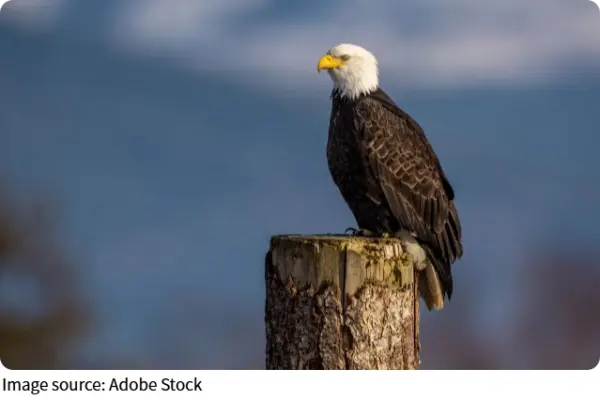
Eagles See the World With Extreme Sharpness
One of the biggest differences between eagle vision and human vision is visual acuity, the ability to detect fine details. Many eagle species, especially large hunters such as golden eagles, have extremely high-resolution eyesight. Their vision is estimated to be several times sharper than that of humans, allowing them to identify objects from distances where humans would only see a blur.
Simple signs to spot a bright, lively kitten before bringing one home
What first-time bird keepers should know before bringing home a chirpy little roommate
Essential Daily Tips for Nutrition, Grooming, Activity, Safety, and Veterinary Care
A close look at how hedgehogs manage food, shelter, traffic, and daily survival in urban spaces
Snow Leopard Conservation: Why Local Communities Are Key to Protecting Mountain Habitats
Why Declining Bee Populations Affect More Than Farms: Food Supply, Prices, and Nutrition
This ability comes from the unique structure of their eyes. Eagles have a much higher concentration of cone cells in their retinas, the light-sensitive cells responsible for detecting detail and color. While humans have hundreds of thousands of cone cells per square millimeter in their central vision area, some birds of prey have a much greater density, giving them exceptional image clarity.
This advantage is essential for hunting. A golden eagle flying high above open terrain can detect subtle movements from far away, helping it locate rabbits, small mammals, or other prey without wasting energy searching randomly.
A Wider View Helps Eagles Control the Sky
Sharp vision alone is not enough for a flying predator. Eagles also need to monitor a huge area while moving through the air at high speeds. Humans have a field of view of around 180 degrees, meaning we can see a wide area in front of us without turning our heads. Eagles, however, can observe a much broader range because their eyes are positioned and structured for aerial hunting.
Their large eyes take up a significant portion of their skull compared with human eyes, allowing them to gather more visual information. This expanded view helps them detect potential prey, competitors, or obstacles while maintaining flight control. For an eagle hunting from above, seeing more of the surrounding landscape means having more opportunities to identify movement before prey can escape.
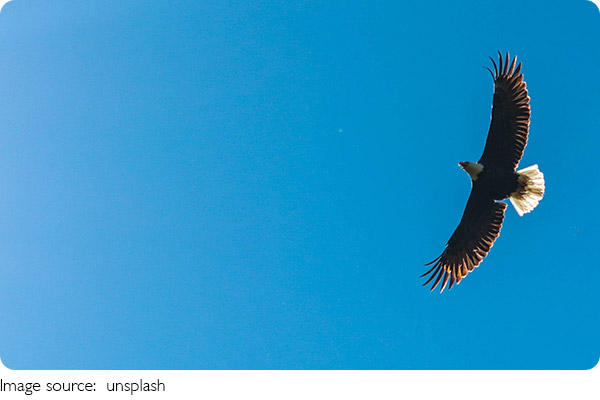
Eagles Can See Colors Beyond Human Limits
Human vision is already impressive because we can distinguish millions of colors using three types of cone cells that respond mainly to red, green, and blue wavelengths. Eagles have an additional advantage. Many birds of prey possess four types of cone cells, including one that responds to ultraviolet (UV) light, a part of the spectrum invisible to humans.
This extra sensitivity gives eagles access to visual information that people cannot experience. Some research suggests that UV perception may help certain birds detect traces left by animals, such as reflective markings from small mammals, because these substances can interact with ultraviolet light. For a predator searching across large landscapes, these hidden signals may provide additional clues about where prey has recently traveled.
Two Focusing Systems for a Faster Hunt
An eagle’s hunting style requires incredible precision. During a dive, it may need to track a moving target while traveling at high speed and adjusting its flight path within seconds. One important feature behind this ability is the eagle’s specialized retina, which contains areas called foveae. The fovea is responsible for sharp central vision.
Humans have one main fovea in each eye, but many eagles have two. This gives them the ability to focus on different areas of their visual field more effectively. One region can help monitor distant objects, while another assists with tracking nearby details. This adaptation is especially valuable during hunting dives, when an eagle must judge distance accurately before reaching its target.
Why Human Eyes Are Different
Although eagle vision appears superior in many ways, human eyesight is not simply an inferior version. It evolved for a completely different lifestyle. Humans rely heavily on close-range vision for activities such as reading, creating tools, recognizing faces, and understanding social expressions. Our ability to interpret small details at short distances has supported communication, creativity, and problem-solving.
Human color vision is also highly developed. The ability to distinguish subtle differences in color helps with identifying objects, interpreting environments, and recognizing important visual signals from other people. Instead of being designed for spotting prey from the sky, human eyes are optimized for interacting with the world around us.
Evolution Created Two Different Visual Experts
The contrast between eagle and human vision shows how evolution shapes animals according to their daily challenges. Eagles became masters of aerial detection. Their large eyes, dense retinal cells, ultraviolet sensitivity, and advanced focusing abilities allow them to function as highly effective hunters.
Humans developed a different type of visual intelligence—one focused on detailed close-range tasks, learning, and social connection. Neither system is universally better. Each represents a solution to a different survival challenge. The eagle’s eyes are built for finding a moving target across vast landscapes, while human eyes are built for understanding and changing the world around us.

The next time you see an eagle circling high above, remember that it is not simply looking down at the landscape. It is experiencing a world filled with details that remain hidden from human eyes. Every movement, color, and distant shape may carry information that helps it survive.