Brown Bear Facts
Pardeep Singh
| 03-09-2026
 · Animal Team
Ursus arctos, the brown bear, is difficult to reduce to a single familiar image. Individuals can vary greatly in size and coat color, their diets shift with place and season, and their behavior changes with circumstances.
A female moving through woodland with cubs offers an especially useful window into the species: feeding, learning, communication, and risk management are all happening within the same family group.
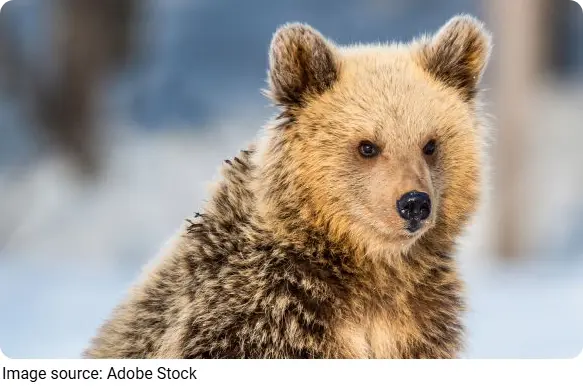
Brown Does Not Mean Brown
The common name creates an immediate identification trap.
Coat color is surprisingly variable
Ursus arctos can range from very dark brown to much paler brown, blondish, or reddish tones. Lighting, wet fur, age, and individual variation can further change its appearance.
How Do Polar Bears Survive The Freezing Arctic? Their Amazing Natural Outfit Reveals A Hidden Survival Secret!
How Do Elephants Remember Water, Family, and Old Paths for Years? Their Memory Is Truly Amazing!
Explore the diverse habitats, diets, behaviors, movements, and adaptations that shape lemur life
Your Cat May Not Need Extra Warmth! Simple Winter Care Mistakes We Often Make Without Realizing It!
Why Do Macaws Form Lifelong Bonds and Learn to Copy Human Speech?
Discover how sea otters thrive in coastal waters through unique adaptations, feeding skills, and tool use
So color alone is a poor identification tool.
Body structure provides more useful clues. Brown bears typically have a noticeable shoulder, a somewhat dished profile, relatively small rounded ears, and long front claws.
Those are physical characteristics. Describing a particular bear as "gentle-looking" because of its face is interpretation—and tells you nothing reliable about how it will respond to your presence.
Cubs Spend Months Learning
Young brown bears are not simply smaller versions of adults following their mother around.
The mother is their survival map
Cubs remain with their mother through an extended period of development. During that time, following her exposes them to feeding areas, travel routes, resting places, and responses to potential danger.
They also spend much of this period moving through the same environments as their mother, encountering the sights, sounds, and smells that make up their daily world. Staying close to her gives the young bears time to develop while benefiting from the protection and experience of an experienced mother.
They Eat More Than Expected
The imposing body of Ursus arctos can make it easy to imagine a diet dominated by large prey. The reality is much broader.
Brown bears are omnivores
Depending on habitat and season, their diet can include grasses, roots, berries, nuts, insects, fish, carrion, and mammals.
Availability matters enormously.
A bear living where seasonal fish are abundant faces a different food landscape from one relying heavily on vegetation and insects. Even the same individual may change feeding priorities as different foods become available through the year.
Standing Is Not a Threat Signal
Few bear behaviors are misread as easily as standing on the hind legs.
Height improves information
A brown bear may stand upright to investigate its surroundings more effectively, including obtaining a clearer view or scent information.
The posture itself does not establish that an attack is about to happen.
That does not make approaching safe. It means observable behavior and human interpretation should remain separate.
"Bear stands and looks toward a sound" describes behavior.
"Bear is preparing to attack" assigns an intention that the posture alone cannot prove.
For wildlife observers, uncertainty should increase caution rather than encourage closer inspection.
A Family Needs Extra Space
Cubs make encounters particularly unpredictable because they do not remain fixed beside their mother.
One cub may mean another is hidden
Vegetation, rocks, fallen timber, and uneven terrain can conceal young bears surprisingly easily.
Never approach a cub that appears to be alone, and never move between cubs and a person. If a family occupies the route ahead, changing direction or retreating is safer than attempting to pass through the group.
Local wildlife authorities may specify minimum viewing distances or other rules. Those location-specific requirements should take priority wherever they apply.
Read Movement, Not Emotions
Wild animals cannot tell observers when a photograph has become intrusive, but their behavior can provide useful evidence.
Look for changes after you appear
A bear that continues its previous activity is behaving differently from one that repeatedly watches you, stops feeding, changes direction, moves its cubs, or leaves the area.
You still cannot know exactly what the animal "feels."
You can know that its behavior changed in your presence.
That is enough information to increase distance.
This is particularly useful with Ursus arctos: instead of trying to label a bear calm, nervous, curious, or angry, watch what it actually does.
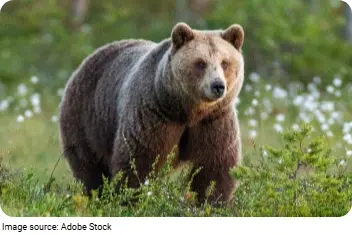
Ursus arctos becomes more interesting when familiar bear stereotypes are removed. Its coat need not be simply brown, its diet is highly flexible, standing upright does not automatically signal aggression, and cubs spend an extended developmental period alongside their mother. The best wildlife observation starts with those measurable details. Watch the animal’s form, food, movement, and family spacing first—and leave guesses about its intentions as guesses.