Rocks That Caught Fire

Ravish Kumar
| 21-10-2026
 · Science Team
Rocks collected from the ocean floor might seem unlikely to catch fire. Yet researchers in the United States have discovered that some deep-sea minerals can spontaneously ignite when exposed to conditions very different from those found underwater.
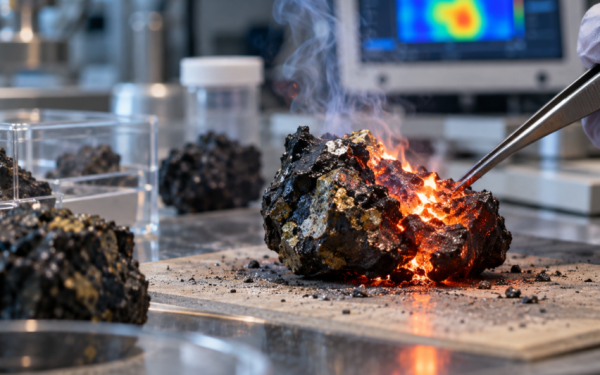
The surprising discovery emerged during an investigation of mineral deposits off the western coast of the United States. Two rock samples became dangerously hot during laboratory processing, raising questions about the safety of future deep-sea mining operations.
The findings were published in the scientific journal Scientific Reports in September 2026.
What Happened In The Laboratory?
In 2022, scientists from the United States Geological Survey (USGS), working with other federal agencies, explored the Escanaba Trough near the Oregon–California border. This underwater region contains hydrothermal deposits rich in metals such as copper, zinc and iron. Using a remotely operated underwater vehicle, the researchers collected 57 rock samples from four areas of the seafloor. Most contained significant quantities of metal sulfides, minerals formed through geological processes involving sulfur and metals. The unexpected reaction occurred when scientists began preparing the samples for analysis.
Scientists have discovered how light can develop unexpected spinning patterns, opening new possibilities for medicine and technology.
Astronomers have traced a mysterious radio burst across more than 10 billion years, revealing new clues about the early universe.
From new materials to smarter designs, battery advances could reshape the future!
Learn why a total lunar eclipse transforms the Moon into a stunning red celestial spectacle
Surprising Engineering Secrets Behind Giant Spinning Turbines
How Face Recognition Technology Challenges Our Privacy Rights.
During freeze-drying and crushing, two samples spontaneously combusted. Temperatures exceeded 100°C, and the original material became completely oxidised.
The incident revealed a potential hazard that had received relatively little attention in discussions about deep-sea mineral extraction.
Why Did The Rocks Ignite?
Initially, researchers considered whether petroleum-like substances trapped inside the rocks might explain the reaction. However, further analysis pointed towards a different cause.
The combustible samples consisted largely of nanocrystalline marcasite, a form of iron sulfide. Marcasite can react with oxygen through oxidation, a chemical process that releases heat under certain conditions.
When the material is crushed or otherwise disturbed, its structure and exposure to air can encourage these reactions. If heat accumulates faster than it escapes, the temperature may continue rising until combustion occurs.
The researchers concluded that the mineral composition and physical characteristics of the samples were crucial to their unusual behaviour.
Why Is Deep-Sea Mining Involved?
Hydrothermal deposits on the ocean floor have attracted increasing interest because they contain economically valuable metals.
Copper and zinc are important industrial materials, while some deposits also contain gold and silver. However, recovering these resources would require transporting mineral-rich rocks from the deep ocean to the surface.
That transition exposes the material to oxygen and changes in temperature, pressure and moisture. Such conditions could alter chemical reactions inside the rocks, potentially causing dangerous heat accumulation.
The researchers warn that these processes deserve careful consideration, particularly when minerals are stored or transported aboard ships.
Are All Deep-Sea Rocks Dangerous?
The discovery does not mean that every rock containing metal sulfides will catch fire.
Only two of the 57 collected samples experienced spontaneous combustion during the reported laboratory procedures.
The findings instead demonstrate that particular mineral compositions may create risks that cannot be predicted from appearance alone.
They also suggest that safety procedures developed for conventional land-based mining may not always be suitable for deep-sea deposits.

What Happens Next?
Scientists recommend investigating how different underwater minerals respond to oxygen, mechanical processing and changing environmental conditions.
Such research could help engineers develop safer methods for handling, transporting and storing potentially reactive materials.
Deep-sea mining also raises broader environmental concerns, including possible damage to fragile marine ecosystems.
The discovery adds another important consideration to debates about extracting resources from the ocean floor.
Before large-scale operations begin, understanding the chemical behaviour of these minerals could prove essential for protecting both workers and the marine environment.