Safe Tunnel Driving

Nolan O'Connor
| 03-11-2026
 · Auto Team
A tunnel looks simple from the outside, just a hole in the mountain with a road running through it.
But the moment you cross the threshold, several things change at once, and most drivers are not set up for any of them. Here is what shifts, from the light and your sense of speed to lane choice, attention and the exit, and how to prepare for each.

The light drop happens fast
On a bright afternoon you might cruise toward the entrance at 60 mph with your pupils squeezed down tight. The interior of a tunnel can sit at a small fraction of that outdoor brightness, and your eyes need several seconds to adjust. Lighting engineers call this the black hole effect, which is why many tunnels put their brightest lamps in the entrance zone.
Can Europe balance cleaner cars with industry needs? EU lawmakers agree to ease future CO2 targets!
A $120,000 sedan and a $400,000 coupe share a showroom. Here's where the extra money actually goes
Discover how aerodynamic design, airflow, and downforce help rear wings improve vehicle grip, stability, and performance
EU leaders disagree over new carbon charges on petrol and home heating, raising questions about household costs and climate goals.
New European safety rules require cars to detect pedestrians and cyclists, bringing advanced technology to everyday driving.
Chinese carmakers doubled their Paris Motor Show presence, showcasing ambitious European plans, advanced tech and fierce competition.
At 60 mph you cover roughly 88 feet every second, so a two-second adjustment window is nearly 180 feet of road you are taking in with weaker vision. Some long tunnels, such as the Eisenhower Tunnel on I-70 in Colorado, run for over a mile and a half, and the light stays low the whole way.
Taking your sunglasses off before the portal and glancing at the lane markings as you go in helps your eyes start adapting sooner. Switch on your headlights too, even in daylight. Many tunnels post signs asking for them, and they make your car easier to see for drivers ahead and behind.
Speed reads differently inside
Walls close in on both sides, and the reference points you use to judge speed disappear. Instead of open fields and distant signs, you get a repeating band of tile or concrete. Drivers often drift faster without noticing.
Do not just trust your sense of pace. Check the speedometer as you enter and hold it steady. If the tunnel carries a lower posted limit, that number exists for the narrower lanes and shorter sight distance, not to slow you down for fun.
Your position needs deciding early
Lane changes inside a tunnel are restricted in many jurisdictions, and some tunnels ban them outright. Decide your lane before the entrance, usually 200 to 300 feet out, and commit. Keep a longer following gap than you would outside, because a breakdown or a stopped vehicle inside leaves little room to swerve.
The Chesapeake Bay Bridge-Tunnel, which runs about 17 miles with two submerged sections, shows why this matters. There is no shoulder in the tube, so a gap you can stop inside is your main safety margin.
Air and attention both shift
Ventilation systems handle the exhaust, but the air inside can still feel different. Setting the climate control to recirculate for the length of the tunnel keeps most of the fumes out of the cabin.
More important is attention. The repeating walls and steady hum make the drive feel monotonous, and that is exactly when your focus slides. Keep your eyes moving, check the mirrors, and watch for brake lights ahead. If the radio is loud, ease the volume so you can catch horns or alarms.
Plan the exit too
Coming out, the reverse problem hits. Bright daylight floods in and your eyes have to readjust all over again. Ease off the accelerator slightly as you approach the exit, give yourself a beat to see clearly, and only then resume normal speed.
Drivers who blast out at full pace often misjudge the first curve or the traffic queued beyond the portal. Conditions can also change at the exit: the road may be wet after a dry tube, and tunnels on mountain or coastal routes can open straight into a crosswind.
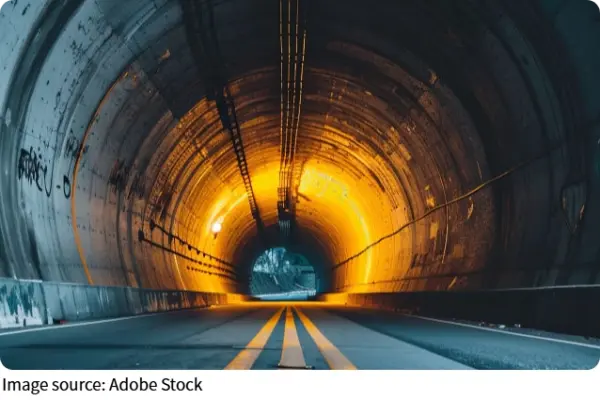
Before the next tunnel entrance, run through a short routine: shades off, lights on, speed checked, lane picked and gap widened. It takes about ten seconds, and treating the approach as a task of its own makes the drive through calmer.