Bears on the Drift

Arvind Singh
| 22-09-2026
 · Animal Team
Good Day, Readers! Imagine walking across a road that never stays in the same place. Beneath polar bears, sea ice drifts with wind and currents, while gaps can suddenly appear.
This shifting landscape makes every journey challenging. Polar bears must adjust their routes, follow scents, and conserve energy. Each trip across the ice becomes a careful test of survival.
The Ice Moves While the Bear Walks
A polar bear can travel across sea ice without its position changing as much as expected because the ice itself is moving. Winds and ocean currents push frozen sea water across the Arctic, a process known as sea ice drift. In Hudson Bay, winter sea ice can drift several kilometers in a day. As a result, a bear resting on the ice may be transported considerable distances without taking a single step.
How does one penguin stand out in a crowded colony? Their mate-finding ritual may surprise you!
Tears on a seal's face?! The real reason may be stranger than you think!
Chimpanzees can remember familiar faces after decades apart, showing a surprising social memory once thought unique to humans!
One bird, one human, two visions! The hidden power behind an eagle’s sharp sight.
Simple signs to spot a bright, lively kitten before bringing one home
What first-time bird keepers should know before bringing home a chirpy little roommate
The opposite can happen when a bear walks against the direction of the drifting ice. Imagine trying to walk forward on a moving walkway that is traveling backward. The bear may spend considerable energy walking, yet its geographical position changes only slightly because the ice is carrying it in the other direction.
This is an important detail when scientists examine satellite tracking data. A line on a polar bear tracking map does not represent walking alone. The recorded movement reflects two things happening at once: the bear's own travel and the movement of the sea ice beneath it.
Not All Sea Ice Looks Equally Useful
Polar bears do not simply move randomly across whatever ice happens to be nearby. The characteristics of the surrounding habitat can influence where they go. Researchers use statistical approaches called habitat selection functions to examine these choices. Instead of asking only how far a bear traveled, scientists can investigate whether particular environmental features make one location more attractive than another.
Research involving polar bears in western Hudson Bay has identified sea ice concentration and distance from denning areas as important factors in habitat selection. Other studies, including work in the Barents Sea, have pointed to features such as water depth, proximity to open water, and distance from shore.
The preferred conditions can also change with the season. During spring breakup in Hudson Bay, for example, bears may remain closer to shore as the remaining patches of sea ice disappear. Their decisions are therefore connected to the seasonal life of the ice rather than following one fixed route throughout the year.
Individual differences matter as well. Age, reproductive condition, and previous experience can influence how a bear responds to the same landscape. Two animals in the same region may therefore make different movement decisions.
Wind Can Help Bears Find Food
Sometimes the most important information for a traveling polar bear is not visible at all. Polar bears have a highly developed sense of smell, and airborne scents can provide clues about potential food. Research has found that bears may travel crosswind, particularly during periods when hunting activity is common. Moving across the wind allows a bear to sample a broader area for scents carried through the air.
If an interesting odor reaches the bear, it can change direction and move upwind toward the possible source. This creates movement patterns that may appear strange when viewed on a tracking map. A bear does not necessarily travel in a straight line toward a predetermined destination. Its route can bend or shift as environmental information changes around it. A seemingly indirect journey may therefore represent an active search strategy rather than wasted movement.
Open Water Changes the Cost of Travel
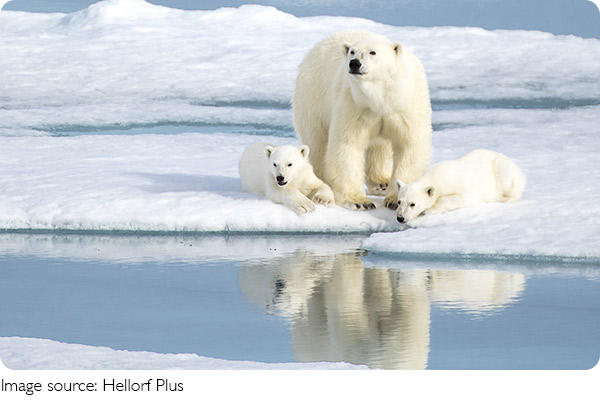
Sea ice does not form one perfectly continuous sheet. It can become fragmented, leaving leads, narrow gaps, pools, and areas of open water between sections of frozen surface. For a polar bear, the difference between walking and swimming can be energetically significant.
Although these animals are powerful swimmers, swimming requires substantially more energy than walking at comparable speeds. When the ice becomes heavily fractured, a bear may need to alternate between walking and swimming, making the journey more demanding.
This is especially relevant in places such as Hudson Bay, where the annual freeze-and-melt cycle forces polar bears to move between land and sea ice as conditions change. Scientists are now examining whether bears choose routes that minimize these energetic costs.
Researchers at the University of Utah, including Jody Reimer and Rylie Gagne, have developed methods for identifying potentially efficient paths through landscapes with varying arrangements of ice and water. The idea is fascinating: instead of simply asking where a bear went, researchers can ask whether the animal selected a route that reduced the physical effort required to reach its destination.
Tracking Reveals Only Part of the Journey
Satellite collars have transformed scientists' understanding of polar bear movements, but tracking data still has limitations. A collar may record a bear's location only at intervals separated by hours. Scientists can compare two recorded positions and see that the animal moved between them, but they cannot always determine exactly what happened during that period.
The bear might have walked around an unstable section of ice, crossed a narrow stretch of water, followed a scent, stopped to rest, or changed direction several times. Those details can disappear between tracking points. To fill this gap, researchers are exploring additional methods, including drones that can document tracks left by polar bears on snow and sea ice.
Physical tracks can provide a much finer picture of how an animal actually moves through a complicated surface. That information could eventually help scientists compare real bear movements with predicted energy-efficient routes.
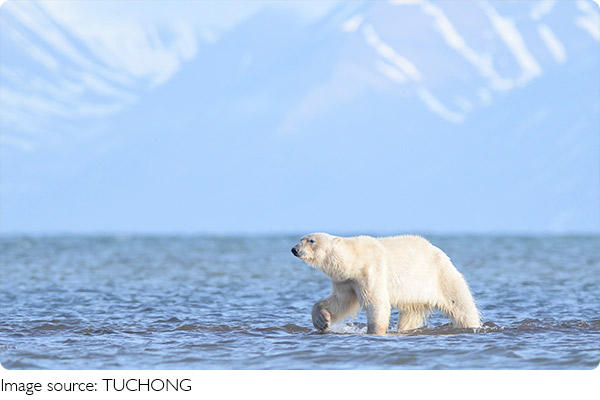
A polar bear's journey across sea ice is not simply a matter of walking from one point to another. The ice itself is moving; the distribution of open water can change; wind carries scents across the landscape; and seasonal conditions alter which habitats are useful.